Why Your Clinic May Not Have a Patient Problem — It May Have a Trust Problem
A patient may already be interested, comparing clinics, and close to booking. The hesitation often happens before WhatsApp — when credibility, safety, proof, and the next step are not clear enough.
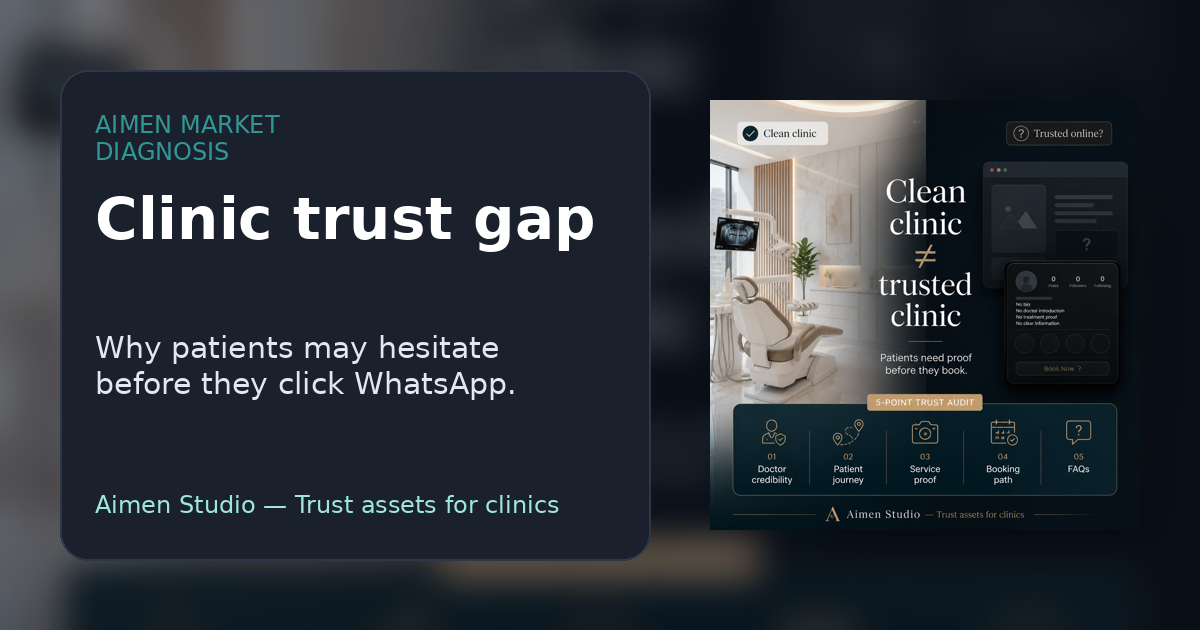
Many clinics assume the problem is simple: “We need more patients.”
But sometimes the real issue appears earlier in the decision journey.
A patient may already be interested. They may already need the treatment. They may already be comparing clinics. The hesitation happens before they send WhatsApp, before they book, and before they trust the next step.
In many public clinic journeys, the visible gap is not demand. It is trust clarity.
The hidden moment before WhatsApp
Before a patient contacts a clinic, they often ask quiet questions:
- Who is the doctor and why should I trust them?
- Is this treatment safe for my condition?
- What will the process feel like?
- Is the clinic experienced with cases like mine?
- Are there real examples, reviews, or proof?
- What happens after I click WhatsApp?
- Will I be pressured, educated, or guided?
If those questions are not answered clearly, the patient may delay. They may compare another clinic. They may save the post and never return.
That hesitation can look like a lead problem, but it may actually be a trust problem.
Public signal disclaimer
This article uses anonymized public-signal patterns only. It does not claim any named clinic has this problem. Actual bottlenecks must be confirmed by the owner or team.
Common trust gaps in clinic marketing
1. Doctor credibility is present but not structured
A clinic may have qualified doctors, years of experience, and strong treatment capability, but the proof may be scattered across posts, captions, bio links, or old pages.
Patients do not always have time to investigate. They need a fast trust path.
A strong clinic profile should make credibility visible in seconds:
- doctor introduction
- specialization
- treatment experience
- safety approach
- patient education style
- clear next step
2. Treatment safety is explained too late
For dental, aesthetic, dermatology, fertility, physiotherapy, and other care categories, patients are not only buying a service. They are weighing risk.
If the content only says “book now” or “promo available,” it may not answer the deeper concern: “Is this safe for me?”
Trust content should explain:
- who the treatment is for
- who it may not be for
- what consultation checks first
- what the process involves
- what realistic outcomes look like
3. The booking path creates friction
Some clinics have active Instagram, Google visibility, and WhatsApp links, but the patient journey still feels unclear.
A patient may wonder:
- Should I ask price first?
- Do I need consultation first?
- What information should I prepare?
- Is the WhatsApp admin responsive?
- Can I choose a doctor or schedule?
A better path turns WhatsApp from a generic chat button into a guided next step.
4. Social proof exists but does not support decisions
Reviews, testimonials, media features, before-after visuals, and patient education can all build trust. But if they are not organized around patient concerns, they become noise.
A clinic trust system should connect proof to objections:
| Patient question | Trust asset needed |
|---|---|
| “Is the doctor credible?” | Doctor profile proof |
| “Is the result realistic?” | Educational case explanation |
| “Is the process safe?” | Safety/process content |
| “Is the clinic responsive?” | Booking journey clarity |
| “Can I trust this clinic locally?” | Google/review/local proof |
The Aimen system: Clinic Trust Profile System
Aimen’s Clinic Trust Profile System turns scattered public-facing assets into a clearer patient decision journey.
The system can include:
- Clinic trust audit
- Doctor and treatment profile structure
- Website or landing page trust section
- Company/clinic profile video concept
- SEO article plan for high-intent treatments
- UGC/avatar education scripts
- WhatsApp pre-booking message structure
- Carousel and short-form video cutdowns
The goal is not to make generic medical content. The goal is to help patients understand why the clinic is credible, what the next step is, and what they should ask before booking.
What a better clinic journey can look like
A stronger journey may look like this:
→ Opens clinic profile or website
→ Understands doctor credibility and treatment safety
→ Sees proof and next-step explanation
→ Clicks WhatsApp with a clearer question
→ Admin guides consultation or booking
This journey does not guarantee bookings or revenue. It simply removes avoidable confusion before the patient contacts the clinic.
Clinic Trust Audit checklist
Use this quick checklist:
- Can a new patient understand your clinic’s credibility in 10 seconds?
- Is the doctor or treatment authority easy to find?
- Does your website or profile answer safety concerns?
- Are reviews, testimonials, or patient stories connected to actual objections?
- Is WhatsApp positioned as a guided next step, not just a button?
- Do your posts educate, reassure, and direct — or only promote?
- Does your clinic have one clear page or content path for high-value treatments?
If three or more answers are unclear, your clinic may not need “more content” first. It may need a trust journey.
Request a Clinic Trust Audit
Aimen can review the public-facing patient journey and produce a practical Clinic Trust Audit:
- visible trust gaps
- website/profile conversion issues
- content angles based on patient hesitation
- UGC/avatar script ideas
- WhatsApp follow-up angle for approved outreach
- recommended next trust asset
This is a diagnosis-first offer. No public signal is treated as confirmed truth until the clinic owner or team validates the real bottleneck.